Where is it cool in Europe right now? The shade list.
The places where a July afternoon averages 15–24°C while the south burns: the Norwegian coast, the Atlantic islands, the Nordic cities, Ireland and one Alpine village. With the trade-offs stated plainly.
When southern Europe heads past 40°C, the useful question flips. Not where it's hot, but where you can spend a whole day outside without hiding from the afternoon. Most of the answers are north and west, and they come with trade-offs: colder sea, more rain, a jacket in the evening.
The shade wheel gives the live answer. It reads the same 14-day forecasts as the sun wheel and only lands on places where daytime highs sit in the 12–22°C band, steady and dry. What follows is the standing geography behind it. The temperatures are long-term averages for the afternoon high, in July unless noted; the sources are listed at the end.
The Norwegian coast, south to north
Bergen is the entry point: about 19–20°C on an average July afternoon, fjords on the doorstep, and food good enough that UNESCO has counted Bergen as a City of Gastronomy since 2015. The rain is real: around 200 days a year bring more than a millimetre. If you can choose, May and June are the driest months, and August is noticeably wetter than July. Bergen gets heat too, now and then: 33.4°C on 26 July 2019.
Helgelandskysten is the stretch most visitors never hear of: the coast of southern Nordland, from the Trøndelag border up to the Arctic Circle. The Seven Sisters range stands above Sandnessjøen, Torghatten has its hole straight through the mountain near Brønnøysund, and the Vega archipelago has been on UNESCO's World Heritage list since 2004. July afternoons average about 18°C at Brønnøysund. It is the quietest place on this list by a distance.
Lofoten puts white-sand beaches under mountains that climb straight out of the sea to around 1,000 metres, well above the Arctic Circle. Afternoons average about 16°C in July. The sea peaks at roughly 12–14°C in August, which is why the surfers at Unstad stay in thick wetsuits all summer. The sun doesn't set from about 25 May to 17 July, so a hike at 23:00 happens in full daylight.
Tromsø is the far end: about 16°C on a July afternoon and the midnight sun from late May to late July. Summer here means fjord boats, hikes and the cable car up to Storsteinen. The whale trips are a winter thing, from November to January, when orcas and humpbacks follow the herring in. If the goal is maximum contrast with Seville, this is it.
The islands that don't overheat
Reykjavík averages about 15°C on a July afternoon and under 12°C across the whole day. For someone leaving a 40°C heatwave that number reads like a typo, then like relief. Geothermal pools take the edge off the evenings, the Golden Circle and the south-coast waterfalls run on near-endless daylight, and summer is the city's busy season.
Isle of Skye holds about 17°C in July and rains on more days than not, around 220 a year. That's the honest price for the Cuillin ridge, the Quiraing and the Fairy Pools. Midges are out from late spring to late summer and worst on still, damp evenings; a head net is not a joke purchase.
Newquay and the north Cornish coast reach about 19°C on an August afternoon, with a sea of 16–17°C: properly swimmable for Northern Europeans, character-building for everyone else. The catch is August itself. It is the peak of the English school holidays, and the lanes and the beaches show it.
Bornholm is the Danish answer: about 20°C in July, an island Danes call solskinsøen, the sunshine island, smokehouses that take herring as seriously as it sounds, and a Baltic of 18–19°C in August, 20°C in a warm summer. With Kristiansand, it comes closest to a conventional beach holiday.
The cool cities
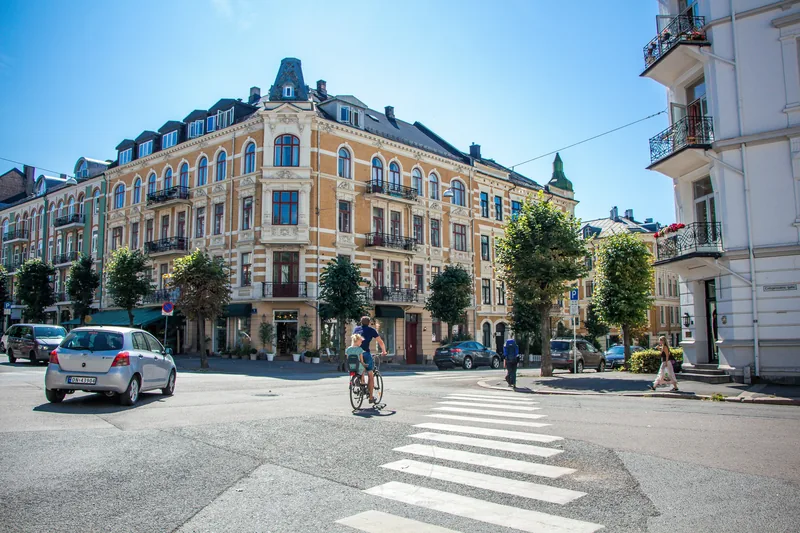
The list above is mostly nature. A heatwave escape can also be a city break: the Nordic capitals and coast cities are walkable, light until late and built around water you can swim in. They are the warm end of the shade list. An average July afternoon in Oslo, Stockholm or Copenhagen is 22–24°C, just above the 12–22°C band the shade wheel looks for, so they come up on it mostly in cooler weeks.
- Copenhagen: about 22–23°C, and harbour baths in the middle of the city. Islands Brygge was the first.
- Stockholm: about 23–24°C, a capital spread over 14 islands, with an archipelago of tens of thousands more a boat ride away.
- Helsinki: about 22°C, a Baltic design city where you take the ferry to the Suomenlinna sea fortress and sauna between swims.
- Oslo: about 23°C, swimming off fjord islands that the city ferries reach, floating saunas and the opera-house roof. The warmest of the cool cities, and it can spike: Blindern measured 34.6°C on 27 July 2018.
- Gothenburg: about 22–23°C, Sweden's seafood coast, and a car-free southern archipelago with ferries from Saltholmen. Halfway between Oslo and Copenhagen.
- Trondheim: about 20°C, the medieval cathedral city, with old warehouses along the river Nidelva.
- Kristiansand: about 21°C on the Skagerrak coast, the sunniest part of Norway, with real sand beaches and the country's largest zoo. The warm, beachy end.
- Strömstad: a small Swedish border town that Norwegians know for cheaper shopping, and the ferry port for the car-free Koster islands, 45 minutes out and surrounded by Kosterhavet, Sweden's first marine national park.
West, on the Atlantic, Ireland is cool by default, and sold on light and coast rather than swimming:
- Galway: high-teens afternoons, a major centre for traditional music, cold dips off the Blackrock diving tower at Salthill, and the Cliffs of Moher and the Aran Islands within reach.
- Cork: about 19°C. It calls itself Ireland's food capital and the English Market makes the case. Cobh, down the harbour, was the Titanic's last port of call.
Altitude instead of latitude
Zermatt solves heat by going up rather than north. At about 1,600 metres, July afternoons average 20°C and August nights about 8°C, and the cable car up the Klein Matterhorn reaches a station at about 3,820 metres with snow on the glacier all year. Swiss prices apply, but in a heatwave summer a car-free village under the Matterhorn at 20°C is a strong trade.
What you trade
None of these replaces a Mediterranean beach week, and pretending otherwise is how people end up disappointed in a beautiful place. The sea runs from about 12°C off Lofoten to 18–19°C in the Baltic in August, against roughly 23–26°C in the western Mediterranean (the monthly sea-temperature guide has the figures). Rain is a live possibility everywhere except in a settled high-pressure week. Evenings want a jacket. And the north does get heatwaves: Oslo's 34.6°C and Bergen's 33.4°C are records, not normal summers, but they happened.
What you get back is the original point of a summer holiday: being outside, all day, comfortably. If you want the halfway version, warm and swimmable without the furnace, that's the Atlantic list in hot, but not too hot. If a heatwave is already forecast for a trip you've booked, read what to do about it. And if your dates can move instead of your destination, June and September take most of the heat risk out of the Mediterranean, though not all of it.
Where the numbers come from
Afternoon highs are 1991–2020 averages unless noted: MET Norway's Seklima for the Norwegian places, the Icelandic Met Office for Reykjavík, SMHI for Stockholm and Gothenburg, DMI for Copenhagen and Bornholm (Bornholm's figure is the older 1971–2000 normal), the Finnish Meteorological Institute for Helsinki, Met Éireann for Cork, the Met Office for Skye and Newquay, and MeteoSwiss for Zermatt. Sea temperatures come from the Institute of Marine Research for Lofoten, the Perranporth wave buoy for north Cornwall and HELCOM for the Baltic off Bornholm. Averages describe a typical summer, not your week; for that, use the shade wheel or the forecast on each destination page.