Hot, but not too hot: Europe's summer sweet spot.
Between the 40°C inland south and the 15°C Arctic summer sits a band of coast where July afternoons average 23–29°C and the sea is swimmable. It's mostly Atlantic, and the ocean's cap is strong but not absolute. Here's the map.
The heatwave conversation tends to jump from one extreme to the other: either you bake in Andalusia or you pack a fleece for Reykjavík. Most people asking where it's cooler don't want 15°C. They want something like 25: warm enough for the beach, cool enough to sleep, with no afternoon spent hiding from a heat warning.
That band exists, and it has a shape. It runs down the Atlantic side of Europe, out to Madeira and, in some summers, round to the Baltic. The ocean is the mechanism. Water in the low 20s takes the edge off the air above it, so the coastal afternoon runs well below the inland one: Faro's average July high is about 29°C, while Seville's, two hours inland, is about 36°C. The cap is strong, not absolute. When the wind turns and blows off the hot interior, these coasts get extremes of their own, and they're in the sections below.
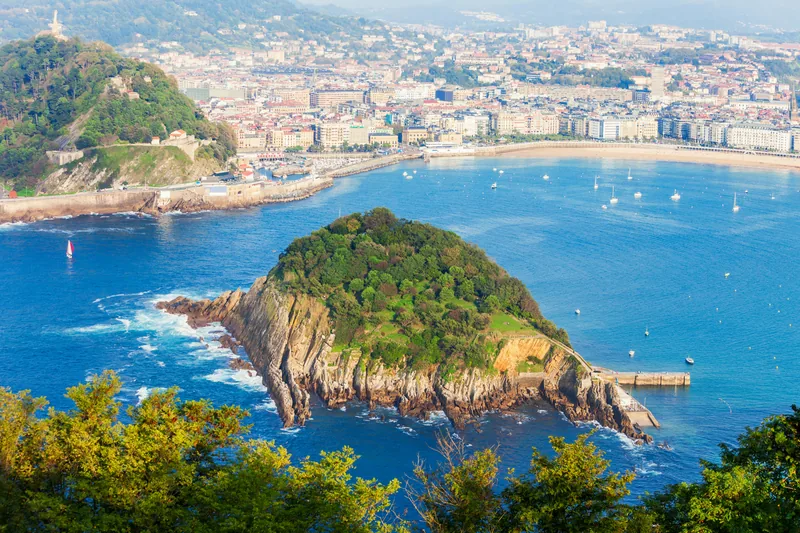
The Basque coast: San Sebastián and Biarritz
San Sebastián averages about 25°C on a July or August afternoon at its airport, with the sea at about 21–22°C in a typical August. Recent summers have run warmer: AEMET classed 23.6°C at the city's aquarium in August 2025 as very warm. La Concha is a proper city beach, the old town's pintxos bars carry the evenings, and when Córdoba passes 40°C, the gap between the two Spains is the whole argument. Biarritz, under an hour up the coast, is the French version: 24–25°C afternoons, surf schools, the same Bay of Biscay water.
Two honest caveats. Biscay weather is Atlantic weather: both towns average nine or ten days with rain in July and again in August, so a couple of grey, showery days a week are normal. And the cap can come off. On 18 June 2022 Biarritz reached 42.9°C and San Sebastián's airport at Hondarribia 42.7°C. Days like that are rare: even 30°C comes on only about three days a month in a Biarritz summer. But they happen. August is also France's and Spain's own holiday month, so expect company. Busy at 25 degrees still beats quiet at 40.
The Algarve, with the sea doing the work
Faro is the warm end of this list: about 29°C on an average July afternoon, 30°C or more on about 13 days in July and 35°C on one or two. What keeps it on the sane side is the Atlantic: the afternoon sea breeze, and water that peaks at about 21–22°C in August off Faro, while the Atlantic-facing west coast stays several degrees colder. The cap isn't absolute here either: Faro's record is 44.3°C, set on 25 July 2004. The simplest cooling trick in town is the ferry out to the Ria Formosa barrier islands, where the breeze comes straight off the open ocean.
Madeira, where the calendar barely matters
Funchal has one of the flattest temperature curves in Europe: about 20°C on a January afternoon, about 27°C in August, and a sea of roughly 18–23°C through the year. Levada walks through the laurel forest, a capital you can actually live in for a week, and very little heatwave history: Funchal averages two or three days a year at 30°C or more. The exception is the leste, the hot, dry wind off Africa that can push a few days well past that. The station's record is 38.2°C, on 9 August 2016. It passes, and the baseline returns.
The Baltic, in the summers when everything flips
Sopot and the Polish coast are the opportunists' entry. A normal July afternoon on the Gulf of Gdańsk is in the low 20s, and the sea at about 17–18°C is pleasant rather than warm: Nordic-adjacent, not a swimming holiday for the cold-averse. But in the heat-dome summers, when high pressure parks over the continent and the south becomes unusable, the coast climbs into the high twenties and briefly has some of the best beach weather in Europe. The sun wheel picks that up when it happens.
When the answer is June or September
If your dates can move, move them instead. September is the stronger of the two: the sea is still close to its August peak and the worst of the heat has usually gone. June is lower-risk than July, not risk-free. June 2025 was the hottest on record in Spain, with Córdoba's and Seville's airports at 43.2°C in its last days. The June and September guides go through it place by place. The Atlantic sweet spot is for people tied to the school-holiday weeks; it solves July and August specifically.
And if even 25°C sounds like too much, the full retreat is the shade list, and the shade wheel picks from it against the live forecast. If a heatwave is already forecast for a trip you've booked, start with what to do about it.
Where the numbers come from
Afternoon highs come from AEMET for San Sebastián's airport at Hondarribia and for Seville (1981–2010), and from Météo-France for Biarritz and IPMA for Faro and Funchal (1991–2020); the same sheets give the rain days, hot-day counts and records. Madeira's sea comes from AEMET's marine climate atlas. These are averages for a typical summer; the forecast on each destination page is what tells you about your week.