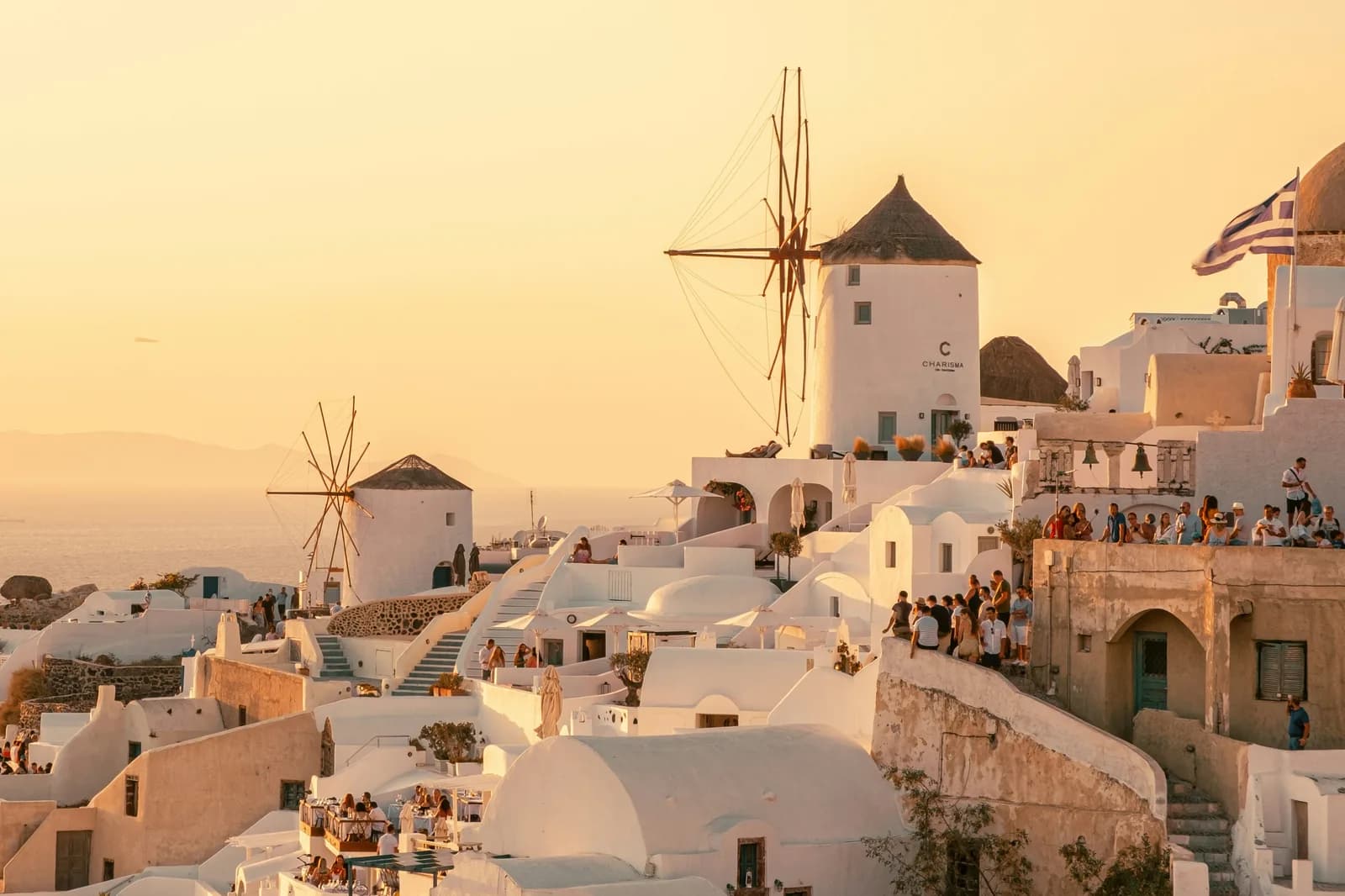
Santorini.
Why Imerovigli beats Oia, how to spot a real caldera view from a fake one, where the locals eat, and the meltemi wind problem.
Santorini is photographed more than any other Greek island and understood by visitors less than most. The headline image — white buildings spilling down a cliff face, blue domes, a sunset somebody else has photographed — is real, but it accounts for maybe 20% of what the island actually is. The other 80% is worth showing up for.
The geography you need to understand
Santorini is the rim of a sunken volcano. The caldera blew open around 1600 BC in the Minoan eruption, drowning what was probably the centre of a Bronze Age civilisation and leaving a crescent-shaped cliff that the modern villages perch on. The cliff runs roughly north–south on the western side of the island. From north to south: Oia, Imerovigli, Firostefani, Fira, then less famous clusters. The east coast of the island is flat, has the airport, has the black-sand beaches (Kamari, Perissa, Perivolos) — and is not on the caldera at all.
This matters because the marketing photographs are of the caldera side, and many hotels on the east-coast beaches advertise themselves with photographs of the caldera that they do not actually face. Always check the hotel's own room photos before booking.
Where to stay (and why not Oia)
Oia gets the famous sunset and roughly 2 million day-trippers a year. The sunset is still beautiful; the experience of watching it elbow-to-elbow with a thousand strangers is less so. We covered this in our Imerovigli article — the short version: stay in Imerovigli, get the same caldera view 30–40% cheaper, walk to Oia for one sunset if you want the famous vantage point, walk back to your quieter hotel for dinner.
If you have one night extra, Pyrgos (the highest village on the island, inland and unfashionable) is the most interesting alternative. Wine cellars, no tourists, sunset views that include the caldera and the rest of the island.
The meltemi wind problem
July and August are hot (32–35°C) but the larger issue is the meltemi — a strong, dry, northerly wind that funnels down through the Cyclades for days at a time. It does three things travellers don't always know to expect: (1) it grounds ferries, including the high-speed catamarans most island-hoppers depend on, (2) it makes the cliffside walking path between Fira and Oia genuinely unpleasant in places, and (3) it interferes with sunset photography by blowing dust over the caldera.
If you're booking July or August, leave ferry days at the start or end of your trip, not the middle. If your itinerary needs you to be in Mykonos by Saturday and the meltemi grounds the ferry on Friday, you have a problem.
The wider Aegean is also now a structural marine-heatwave region — the Ionian Sea recorded 29.5°C on 16 August 2024, the highest reading in Mediterranean history. The 2026 climate study treats midsummer Greek islands as a heat-risk window by default; the shoulder seasons are now the prime seasons.
When to go
The sweet spot is late April through mid-June and mid-September through late October. 22–28°C, swimmable sea (19–20°C by mid-May, 23–24°C in September), and the package tourists either haven't arrived or are gone. May and early June get you the best photographs because the haze hasn't started; late September gets you the warmest sea.
July–August: it works, but you're paying 2–3× the price for a worse experience. Winter (November–March): a different Santorini. Most hotels close, mild but not sunny, prices low. A different trip.
Where the locals actually eat
The cliffside restaurants in Oia and Imerovigli are tourist-oriented — fine views, prices that would embarrass a Parisian. The good food is elsewhere on the island.
- Metaxi Mas in Exo Gonia is the canonical answer. Old wine cellar, grill-heavy menu, locals bringing their parents. Reservations are difficult in peak summer — call the morning of the day you want to go.
- Selene in Pyrgos is the Michelin-touched, Santorini-produce version. Heavy use of Assyrtiko-vine grapes, capers, fava beans.
- Taverna Katina at Ammoudi Bay (down the 300 stone steps from Oia, or down the road if you're driving) grills whatever the boats brought in that morning. Tourist prices, but genuinely some of the best seafood of your life.
The thing to skip: any place in Oia's main pedestrian street that has a greeter outside waving a menu.
The wine you should taste
Santorini grows Assyrtiko, a white grape with high acidity that thrives in volcanic soil. The vines are pruned into circular baskets (the kouloura) to protect them from wind and conserve moisture — a 2,000-year-old technique still in use. Drink one bottle. Santo Wines has the best tasting setup with a panoramic view. Estate Argyros is the more serious version for people who actually want to learn. If nobody in your group wants to stay sober behind a rental-car wheel, the guided three-winery tours solve the logistics — most include hotel pickup.
How to get there
Flying: Santorini airport (JTR) takes seasonal direct flights from most European hubs from May to October. Off-season you connect through Athens. Taxis from the airport to the caldera villages cost €35–50 — there's a Gold Card metered stand at arrivals.
Ferry: Athinios port on the south-west coast. From Athens (Piraeus) it's 5–8 hours depending on which ferry. From other Cyclades islands (Mykonos, Naxos, Paros) it's 1.5–3 hours. The port-to-village taxi situation is theatrical in peak season; book a private transfer through your hotel.
What not to do
- Don't rent a quad or "ATV" without checking your insurance. Accident rates are notorious; one fatal crash a month is the depressing average across the Cyclades in summer.
- Don't ride the donkeys up the Fira cliff steps. They're overworked. Take the cable car.
- Don't drink the tap water in any quantity. Santorini's water is largely desalinated and the taste is recognisable; bottled or filtered is the move.