Greek island hopping 2026: the ferry guide.
How to actually plan a Cyclades or Dodecanese trip in 2026: which ferries run when, where the meltemi grounds boats, how to book seats versus deck class, and the routes that save real time.
The Greek ferry network is the canonical example of "looks chaotic from outside, makes total sense from inside." 75 inhabited islands, four ferry operators, two different boat types running parallel routes at half the speed and price of each other, and a high-summer meltemi wind that grounds the fast catamarans for days at a time but barely slows the conventional ferries down. Plan around the system and the islands open up; plan against it and you spend two days in Piraeus port.
This is the genuinely-useful version of how to do it in 2026.
Two ferry types, and which to use
Fast catamarans (Seajets, Golden Star Ferries highspeed) — 1.5 to 3 hours between most island pairs, €40–70 per leg, all seats reserved, sensitive to wind. These are the boats your hotel concierge will recommend.
Conventional car ferries (Blue Star Ferries, Anek Lines, Hellenic Seaways' Highspeed too) — 2 to 6 hours between island pairs, €25–45 per leg, deck class available, robust against weather. These are the boats Greeks use.
The rule: conventional ferry when you have time, catamaran when you don't. A conventional ferry between Mykonos and Santorini is 4.5 hours and €38; the catamaran is 2.5 hours and €68. The conventional is also far less likely to be cancelled when the meltemi blows.
The meltemi: how to plan around it
The meltemi is a strong, dry, northerly wind that funnels down through the Aegean from late June into mid-September, often blowing 6–8 Beaufort for 3–5 days at a time then dropping for a few days then returning. It is the single biggest disruption to Cyclades ferry travel and the reason "Mykonos to Athens is just a quick ferry" can become a 36-hour airport saga.
What gets cancelled:
- Fast catamarans on exposed routes (Mykonos–Santorini, Naxos–Santorini, anything via Ios)
- Tilos, Symi, and other Dodecanese small-island connections
- Most small Cycladic ferries (the "Express Skopelitis" Naxos–Donousa–Koufonisia line)
What keeps running:
- Conventional Blue Star ferries on the main lines (Piraeus–Paros–Naxos–Santorini, Piraeus–Mykonos)
- The Anek Crete service (Piraeus–Heraklion or Piraeus–Chania)
Plan your ferry days at the start and end of your trip, not the middle. If you need to be back at Athens airport on Saturday, get back to Athens on Friday by whichever ferry runs — don't rely on Saturday morning's catamaran from Mykonos. The 2023 meltemi week in late July stranded an estimated 30,000 tourists on the Cyclades.
The five canonical Cyclades routes
For a one-week trip, pick one of these. Mixing islands beyond three in a week is logistically painful.
A. Mykonos + Santorini
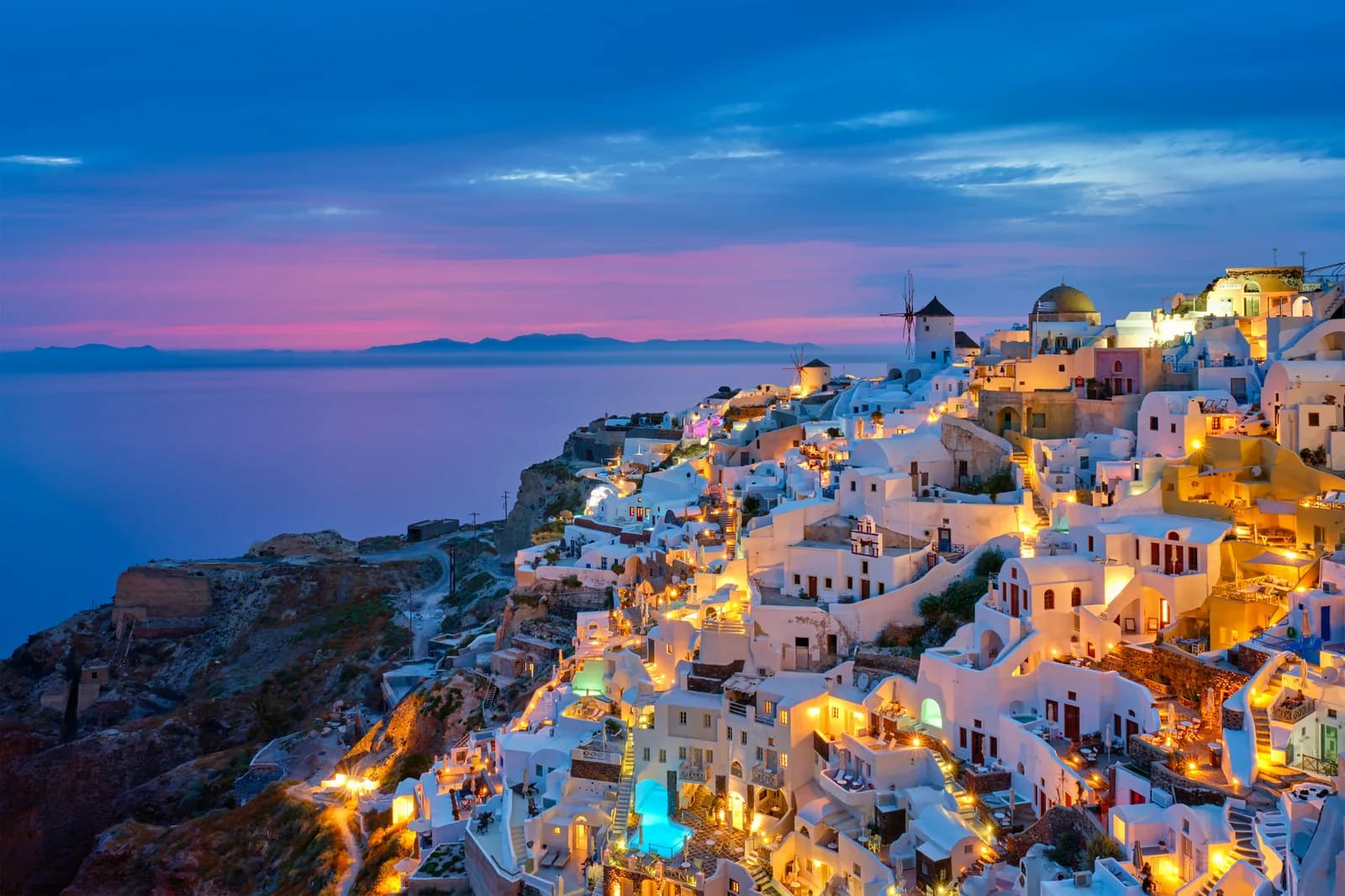
The Instagram circuit. Fly Athens to Mykonos (50 min), four nights Mykonos, catamaran or conventional ferry to Santorini (2.5–4.5 hours), three nights Santorini, fly out from JTR. Watch the meltemi — many couples get stuck doing this in reverse because Santorini's airport handles the late-summer return better than Mykonos's.
B. Naxos + Paros
The Cyclades for people who've been to Mykonos and want the alternative. Naxos is large, low-key, has some of the archipelago's best beaches, and is the only Cycladic island with serious mountain villages (Apeiranthos). Paros is the smaller, more wine-and-food version. Ferry between them: 30 minutes, €15. Both islands have their own airport (small, summer-only direct flights from Athens).
C. Milos + Folegandros + Sifnos
The "Western Cyclades" loop. Milos is the volcanic-beach-by-boat island; Folegandros is the cliff-top village no one had heard of in 2018 and everyone has now; Sifnos is the food island (Greece's best cookbook author, Nikos Tselementes, was Sifniot). All three connected by SeaJets and Hellenic Seaways with same-day Athens connections.
D. Crete-based with one-day Santorini
A day-trip catamaran runs Heraklion to Santorini every morning April–October — 2 hours each way, €78 round trip, in port by 11:00, returns 17:30. Lets you do the Santorini sunset photo without the Santorini hotel prices. Crete itself has enough for two weeks.
E. The Dodecanese: Rhodes + Symi + Kos
Different archipelago, less meltemi exposure, longer ferries. Rhodes-Symi is 60 min by Dodekanisos Seaways catamaran (€20). Rhodes-Kos is 3 hours. Patmos and Lipsi are the over-water-from-Italy religious-tourism circuit, quieter and more atmospheric than the Cyclades.
Booking tactics
Ferryhopper is the cleanest booking aggregator — aggregates Blue Star, Seajets, Anek, Minoan, Hellenic Seaways in one search. Direct booking on operator sites is sometimes €2–5 cheaper but the convenience usually outweighs.
Book at least 2 weeks ahead for July/August on popular routes (Mykonos–Santorini fast cats sell out). Shoulder season (May, June, September, October) — book the day before, except for the start and end of your trip which you should lock in advance.
Deck class vs reserved seat. Conventional ferries offer "Deck/Eco" tickets for €25 (no assigned seat, public seating areas and outside deck) and "Air Type" for €38 (assigned reclining seat in air-conditioned saloon). Greeks routinely take deck — get on early, claim a window booth in the bar/lounge area. For day-time crossings under 4 hours, deck class is fine.
Car or no car. Bringing a car to the Cyclades is expensive (€80–150 per leg) and unnecessary on small islands. Naxos and Crete are large enough that car-rental on arrival is the cleaner choice. Mykonos, Santorini, Folegandros: no car, scooter or local bus.
Piraeus port: the airport-equivalent for ferries
Piraeus is the main Athens ferry port, 25 minutes by metro from Syntagma (Line 1 to Piraeus station, then short walk to the docks). The complex has 12 boarding gates (E1–E12) and is genuinely confusing — give yourself 90 minutes between arriving at port and ferry departure if it's your first time.
Each operator uses different gates:
- Blue Star, Hellenic Seaways → Gates E5–E8
- Seajets → Gates E1–E2 (catamarans)
- Anek Lines (Crete-bound) → Gates E11–E12
There's a coffee chain (Mikel) and a few bakeries, but no real food at Piraeus. Eat in Athens before, or on board.
The genuinely under-the-radar islands
If the Cyclades feel saturated, three lesser-known options worth a week each in 2026:
- Astypalea (Dodecanese) — "Butterfly island", whitewashed castle village, served by Blue Star from Piraeus 3x weekly. Slow. Quiet. A working Greek island with one electric ferry on order from VW.
- Kythnos — closest Cycladic island to Athens (90 minutes by ferry), almost no foreign tourists, Loutra hot springs.
- Kasos — beyond Karpathos, easternmost reach of the Aegean. Connection via ferry from Crete or Rhodes. Genuinely empty in summer.
What to do when ferries get cancelled
Two scenarios.
Catamaran cancelled, conventional still running: Take the conventional. Lose 2 hours, save the trip.
All ferries cancelled (meltemi >7 Beaufort): Aegean Airlines and SkyExpress offer same-day rebooking on most Cycladic-to-Athens routes. Skip the queue at the port and rebook a flight. Costs €60–120 vs the ferry you've already paid for; usually worth it to make a connecting flight home.
The Santorini, Mykonos, Heraklion, and Rhodes destination pages have live forecasts that include the wind speed — useful for deciding when to risk a catamaran versus a conventional ferry.