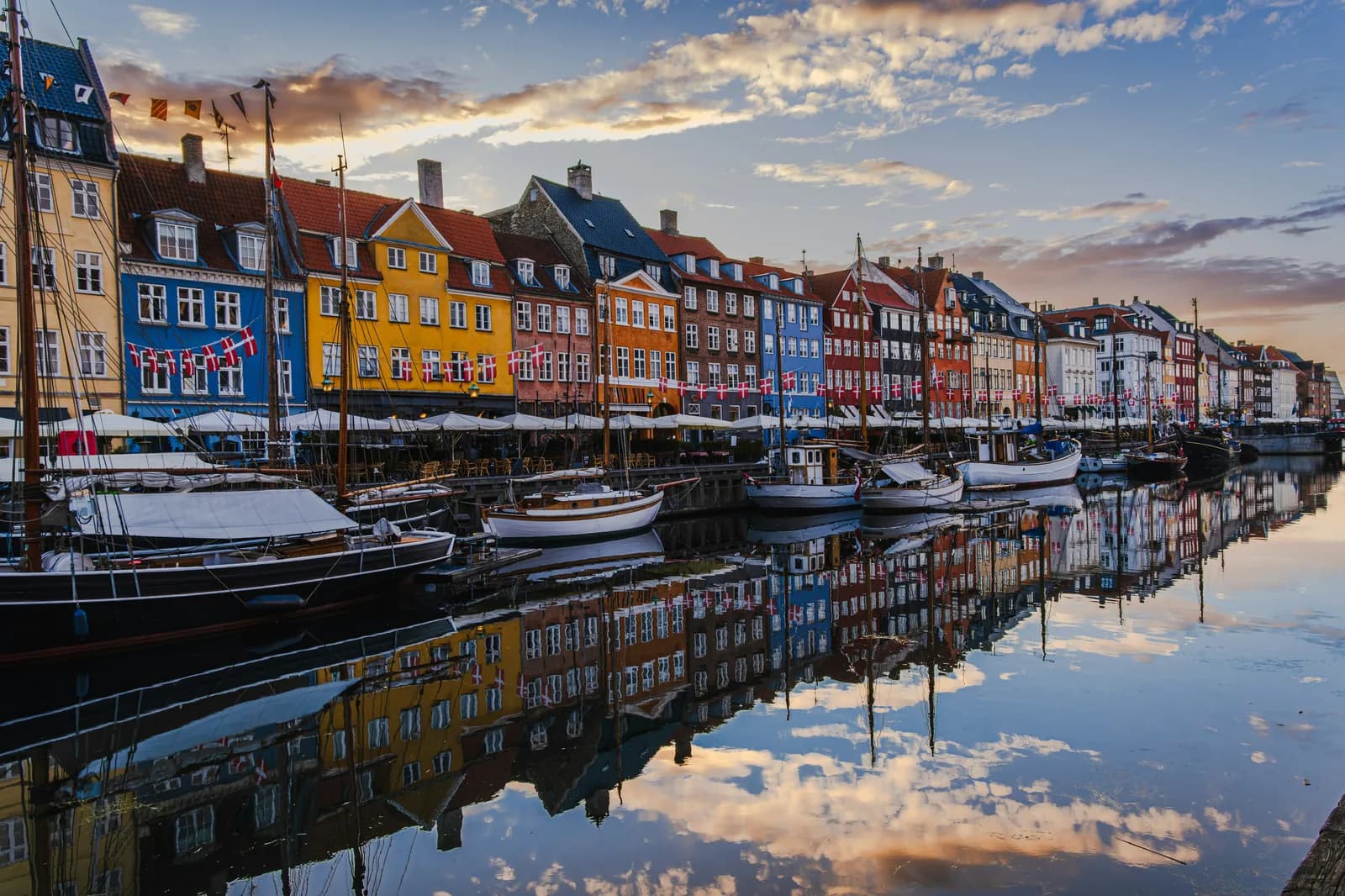
Copenhagen.
The city break that doubles as a heatwave escape: 22°C summers, harbour water clean enough to swim, and a bike-first old town built for being outside all day. Where to swim, stay and eat — and the honest note on Danish heat.
When a heat dome settles over the continent and Rome hits 41°C, the smart money doesn't always fly south to a 19°C Atlantic — it flies north, to a city that does 22°C, stays light until 22:30, and was rebuilt over the last twenty years around the idea that summer happens outdoors. Copenhagen is the best of them. You swim off the city-centre quays, you cycle instead of sweating in taxis, and you eat some of Europe's most interesting food at a fraction of the noma-legend prices. It is, plainly, the most liveable warm-weather city break on the map.
The honest framing first, because this site runs on it: Copenhagen is temperate, not arctic. Most summer days sit at 21–23°C; its own heat spells push 28–30°C for a handful of days most years (it touched 31.7°C in the 2018 heatwave). So it's reliably 10–15°C cooler than the burning Med, with the water and the parks as the release valve — not a guaranteed cold refuge. That's the right expectation, and it's a very good one.
When to go
Mid-May to mid-September is the season, and it's a genuinely long one this far north thanks to the light.
June is the sweet spot: 20–22°C, sunset near 22:00, the harbour baths open, the city in its summer skin before the July crowds. July–August runs warmest (22–24°C, the odd 28°C spike) and busiest. May and early September are cooler (17–20°C), brighter than you'd guess, and noticeably cheaper. Winter is a different, cosy trip — hygge, lights, no swimming.
Getting there
Copenhagen Airport (CPH) is Scandinavia's busiest hub — direct from everywhere, and the Metro runs from the terminal to the centre in 15 minutes (the airport is on the line; no transfer drama). A few stops and you're in the old town. The city itself is then walked and — properly — cycled.
Rent a bike on arrival. Copenhagen is flat, and over half its residents commute by bike on protected lanes that make it genuinely safe for visitors. Donkey Republic and the city's bike-share put a set of wheels under you for a few euros a day, and it converts the whole city into a fifteen-minute town. This is the single best thing you can do here.
Where to stay
Base in Indre By (the medieval core), Vesterbro (the hip former meatpacking district — Kødbyen — with the best nightlife and food), or Nørrebro (multicultural, young, the Jægersborggade strip). Christianshavn across the harbour is the canal-and-houseboat option.
Scandic is the dependable Nordic default here and runs several central hotels — browse Scandic's Copenhagen properties (the Spectrum near Tivoli and the lakeside Scandic Copenhagen are the pick of them), breakfast optional on most rates (cheapest pre-booked with the room), the standard you can book without research. For the wider market — boutique canal-house stays, the design hotels — the Booking strip below carries live prices.
Swim the harbour — the city's best trick
This is what reorganises a Copenhagen summer: the harbour water is clean enough to swim, in the middle of the city. A two-decade clean-up turned the working harbour into a chain of public bathing spots, and on a warm day half the city is in it.
- Islands Brygge Havnebad — the original and best-loved: wooden pontoons and pools right across from the centre, lawns full of picnicking Danes. Free.
- Sandkaj (Nordhavn) — the newer, sleeker harbour bath in the redeveloped north docks; deep clean water, a younger crowd.
- La Banchina — a tiny wine-bar-and-sauna jetty in Refshaleøen where you swim, sauna, and eat sourdough between dips.
Water sits around 18–21°C in high summer — bracing, brilliant, and the thing you'll tell people about. Bring a towel everywhere; you'll use it.
The city itself
- Nyhavn — the postcard canal of gabled townhouses; touristy, photogenic, best as a walk-through to the harbour-bus, not a place to eat.
- Tivoli — the 1843 pleasure garden in the centre: part funfair, part landscaped park, genuinely magic at dusk when the lights come on. Worth the entry even without riding anything.
- Christiania — the self-governing "freetown" on Christianshavn: a 1970s commune-turned-neighbourhood of self-built houses and gardens. Read the rules at the gate, respect the no-photo zones, walk the ramparts.
- The harbour by water — the public harbour buses (line 991/992) are part of the transit system: a fjord-cruise view of the Opera House, the Black Diamond library and the new architecture for the price of a normal ticket. The tourist canal boats cover similar ground with commentary.
- Refshaleøen — the post-industrial east-harbour island: street-food at Reffen, the Copenhagen Contemporary art space, La Banchina's sauna. The city's current creative engine.
For the design-and-architecture crowd, add the CopenHill waste-to-energy plant you can ski (and hike) on the roof of, and a wander through Frederiksstaden's royal palaces.
The food, at human prices
Copenhagen's restaurant reputation is the multi-Michelin tasting-menu tier, but the city eats brilliantly for far less:
- Smørrebrød — the open rye sandwiches are the honest lunch: Aamanns does the elevated version, the basement Schønnemann the century-old institutional one (book).
- Torvehallerne — the glass food-hall by Nørreport: porridge, fish, coffee, the famous Hija de Sanchez tacos, oysters. Grazing lunch HQ.
- Reffen and Broens Gadekøkken — the street-food markets for cheap global plates by the water.
- The hot dog — the ristet hotdog from a pølsevogn cart is the €4 institution; do it once, standing up, with remoulade.
- New-Nordic mid-tier: Restaurant Barr, Pluto, Høst deliver the Copenhagen kitchen without the four-figure bill.
Wash it down with the harbourside micro-brew scene (Mikkeller is the local export) and the summer ritual of a beer on a quay at 21:00 in full daylight.
Day trips worth taking
- Louisiana Museum of Modern Art (35 min by train up the coast to Humlebæk) — one of the world's great museum experiences: art, a sculpture park rolling down to the Øresund, and a café terrace facing Sweden. The single best half-day out of Copenhagen.
- Malmö, Sweden (35 min over the Øresund Bridge by train) — a second country for lunch: the Turning Torso, the old town, falafel capital of Scandinavia. Bring ID.
- Roskilde (25 min) — the Viking Ship Museum and the cathedral of Danish kings; pair it with the festival in late June if your timing's wild.
- Dyrehaven — the royal deer park north of the city, free-roaming deer and the world's oldest amusement park (Bakken) at its edge.
Practical notes
- Money: Danish kroner; cards (and phones) everywhere — Denmark is nearly cashless. Tipping is not expected.
- Cycling etiquette: signal, keep right, don't drift into the bike lane on foot — locals will let you know.
- Light: June nights barely darken; an eye mask helps. Conversely, pack a layer — harbour evenings cool fast.
- Cost: Copenhagen is expensive (Nordic city). The bike, the free harbour baths, the food markets and the parks are how you keep it sane.
The summary
Fly CPH, take the 15-minute Metro, rent a bike before you do anything else. Swim Islands Brygge on the warm afternoons, eat your way through Torvehallerne and a Reffen evening, ride the harbour bus for the architecture, give a day to Louisiana up the coast and an hour to Malmö over the bridge. Go June for the light, September for the value. When the continent is a furnace, this is the city break that feels like the holiday summer was supposed to be — outdoors, in the water, in shirtsleeves at 22°C.